Drone pressure washing explained: why aerial cleaning is really low-pressure soft washing, and how chemistry — not PSI — gets buildings clean safely.
Let’s be precise: drones don’t really pressure wash
People search for drone pressure washing, so let us answer the question honestly: what the industry calls drone pressure washing is, in practice, drone soft washing — a low-pressure application of cleaning chemistry followed by a rinse. No credible operator hangs a 3,000-PSI wand under a drone, and understanding why tells you most of what you need to know about how aerial cleaning actually works.
The first reason is physics. A pressure washer’s cleaning power comes from reaction force — the same jet that scours the wall pushes back on whatever holds the wand. A person braced on the ground absorbs that. A hovering aircraft cannot: a high-PSI jet would shove the drone around the sky, making precise, safe positioning near a building impossible. Aerial systems therefore fly moderate-pressure spray that the aircraft can carry stably, and let chemistry do the work that PSI would otherwise pretend to do.
The second reason is that high pressure was never the right tool for most building exteriors anyway. PSI does not kill the algae and mildew that cause staining — it shears the visible layer off and leaves the organism rooted, which is why pressure-washed surfaces re-streak in months. Soft washing kills growth at the source, so the clean lasts years. The drone did not force this compromise; it adopted the method professionals already preferred.
What high PSI does to real building surfaces
Walk any Florida stucco building that has been aggressively pressure washed and you can read the history: wand marks, etched swirls, blown-out hairline cracks. High pressure drives water through stucco’s natural micro-cracking into the substrate, where it feeds exactly the mold problems the washing was meant to solve. On painted surfaces it strips coatings unevenly. On glass systems it can compromise insulated-unit edge seals. On wood and soft masonry it erodes the surface outright. Pressure is a demolition tool being used as a cleaning tool, and elevated surfaces — where nobody inspects the damage up close afterward — are where it does the most unnoticed harm.
Soft washing inverts the equation: apply a biodegradable, surface-matched solution at little more than rain pressure, give it dwell time to break down growth and film chemically, then rinse. The surface experiences less mechanical stress than a summer thunderstorm delivers, and the biological cause of the staining is dead rather than merely shortened.
Substrate by substrate: how the wash is tuned
Stucco — South Florida’s default skin — is porous and micro-cracked, and it holds biological growth deep in its texture. It gets a soft-wash solution with generous dwell so chemistry penetrates the texture that pressure could never safely reach. EIFS, the foam-backed synthetic stucco, is the most pressure-intolerant common cladding in existence; a jet can punch through its thin lamina. It is cleaned gently or not at all, and drone soft washing is one of the few methods appropriate for it at height.
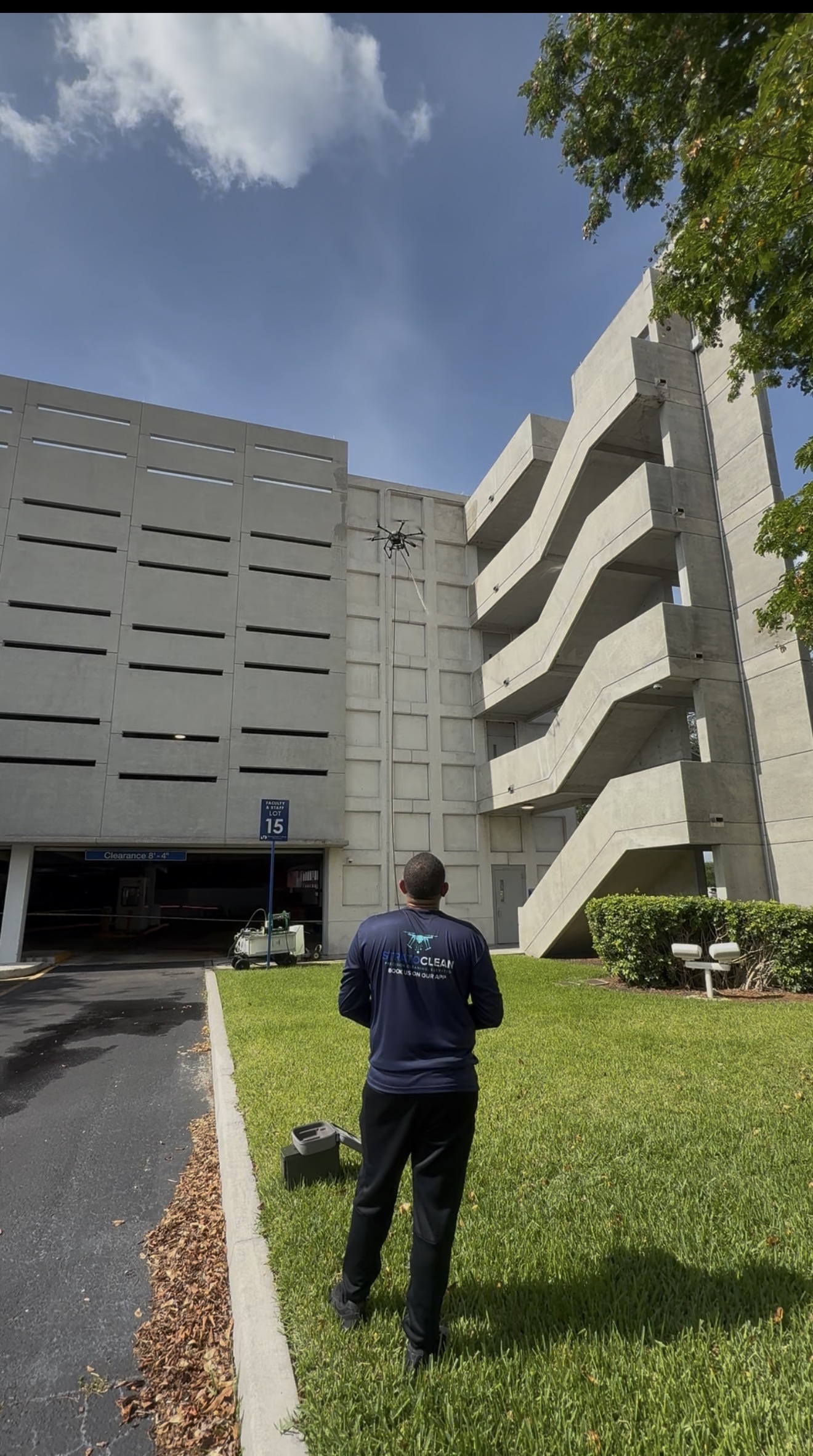
Concrete and masonry tolerate more, but the goal is unchanged: kill the growth, lift carbon film, rinse — as on the elevated garage walls of a Miami college parking structure, washed without lifts or lane closures. Metal cladding and stainless respond to chemistry matched to oxidation; at a professional ballpark in the Palm Beaches, years of salt-driven oxidation left the stainless facade dull, and a chemistry-led wash restored it in a single mobilization. Glass gets glass-safe pressure and a purified-water rinse so it dries spot-free. One method, tuned per material — never one pressure setting for the whole building.
What a drone wash job looks like in practice
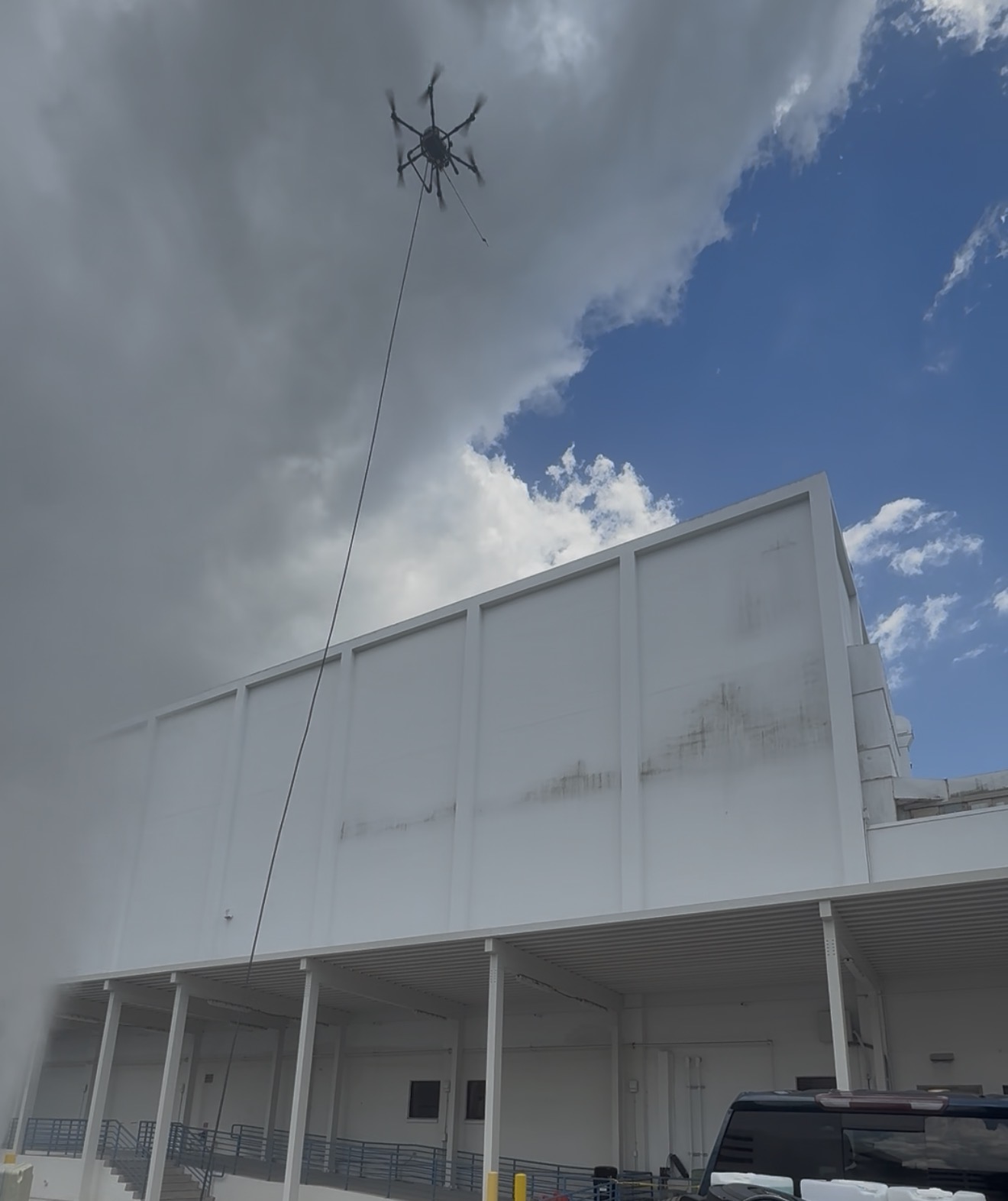
The crew stages ground equipment — tanks, pumps, feed lines — and the aircraft flies the structure in overlapping passes, one elevation at a time: apply, dwell, rinse, top down. Setup takes under an hour; there is no scaffolding to erect, no lift to position, no anchors on the roof. On sites with public sidewalks or adjacent lanes, our team holds FDOT Temporary Traffic Control Advanced certification and sets its own work-zone control, and wash-water planning is led by an FDEP-trained Qualified Stormwater Management Inspector on the team.
The honest limits apply here as everywhere: wind holds the aircraft, some airspace requires authorization lead time, and chemistry needs dwell time — a drone wash is methodical, not instant. But for elevated exterior surfaces, the combination of soft-wash chemistry and aerial delivery replaces the two most dangerous and expensive elements of traditional work: high pressure on fragile substrates, and people suspended at height to deliver it.
Frequently Asked Questions
Is drone pressure washing real?
The service is real; the name is imprecise. Cleaning drones perform low-pressure soft washing — applying biodegradable cleaning solution and rinsing — not high-PSI blasting. A hovering aircraft cannot brace against a pressure jet’s reaction force, and high pressure is the wrong approach for most exterior surfaces anyway. Chemistry does the cleaning.
How much pressure does a cleaning drone use?
Roughly the force of heavy rain — enough to distribute solution evenly and rinse thoroughly, never enough to etch stucco, strip paint, or stress glass seals. The cleaning power comes from a surface-matched solution and its dwell time, not from PSI.
Why not just pressure wash the building the traditional way?
Three reasons: high pressure damages common Florida substrates like stucco and EIFS and can drive water into the wall; it does not kill algae and mildew, so staining returns within months; and reaching elevated surfaces traditionally requires lifts, scaffolding, or workers suspended at height. Soft washing by drone addresses all three at once.
Does soft washing clean as well as pressure washing?
It cleans better where it matters. Pressure shears the visible layer of growth off and leaves the organism alive; soft-wash chemistry kills algae, mildew, and bacteria at the root, so surfaces stay clean for years instead of months. On carbon film and oxidation, matched chemistry outperforms raw PSI without the surface damage.
What surfaces can a drone soft wash safely clean?
Stucco, EIFS, concrete, masonry, metal cladding, stainless, painted surfaces, architectural glass, tile and shingle roofs on residential homes, and solar glass. The solution, dilution, and dwell are tuned to each substrate — EIFS and glazing get the gentlest treatment, concrete and masonry tolerate stronger chemistry.
Is the runoff from a drone soft wash safe?
The solutions are biodegradable and wash-water management is planned before spraying begins — job planning at StratoClean is led by an FDEP-trained Qualified Stormwater Management Inspector, covering inlet awareness, work sequencing, and documentation. On residential roof work, landscaping is pre-soaked, post-soaked, and treated with a neutralizer.
Related Services & Areas
- soft wash services
- drone building cleaning
- how drone roof cleaning works
- how drone window cleaning works
- concrete and wall cleaning
- all drone cleaning services
Get a Straight Answer for Your Building
Tell us what you’re maintaining and we’ll tell you exactly how we’d clean it — method, timeline, and a firm number. Call (786) 244-0640, email info@stratoclean.com, or get an instant roof quote online.