How does drone roof cleaning work? Soft-wash chemistry kills roof algae at the root with zero foot traffic — a step-by-step guide for Florida homeowners.
What those black streaks on your roof actually are
The dark staining on Florida roofs is not dirt — it is alive. The primary culprit is Gloeocapsa magma, a cyanobacteria that feeds on moisture and, on shingle roofs, on the limestone filler inside the shingles themselves. It spreads as airborne spores, colonizes the shaded and north-facing slopes first, and darkens as it grows a protective pigment against the sun. Alongside it come algae, lichen, and mold, all thriving in South Florida’s humidity. Because the growth is biological, any cleaning method that merely blasts the visible layer off leaves living organisms and spores behind — which is why pressure-washed roofs streak again within a year.
Soft washing takes the opposite approach: a low-pressure application of cleaning solution that kills the growth at the root, spores included. The roof is not scoured; it is treated. Killed growth releases from the surface and the roof rinses clean — and because the organism is dead rather than trimmed, the roof stays clean for years instead of months.
Why the drone matters: nobody walks on your roof
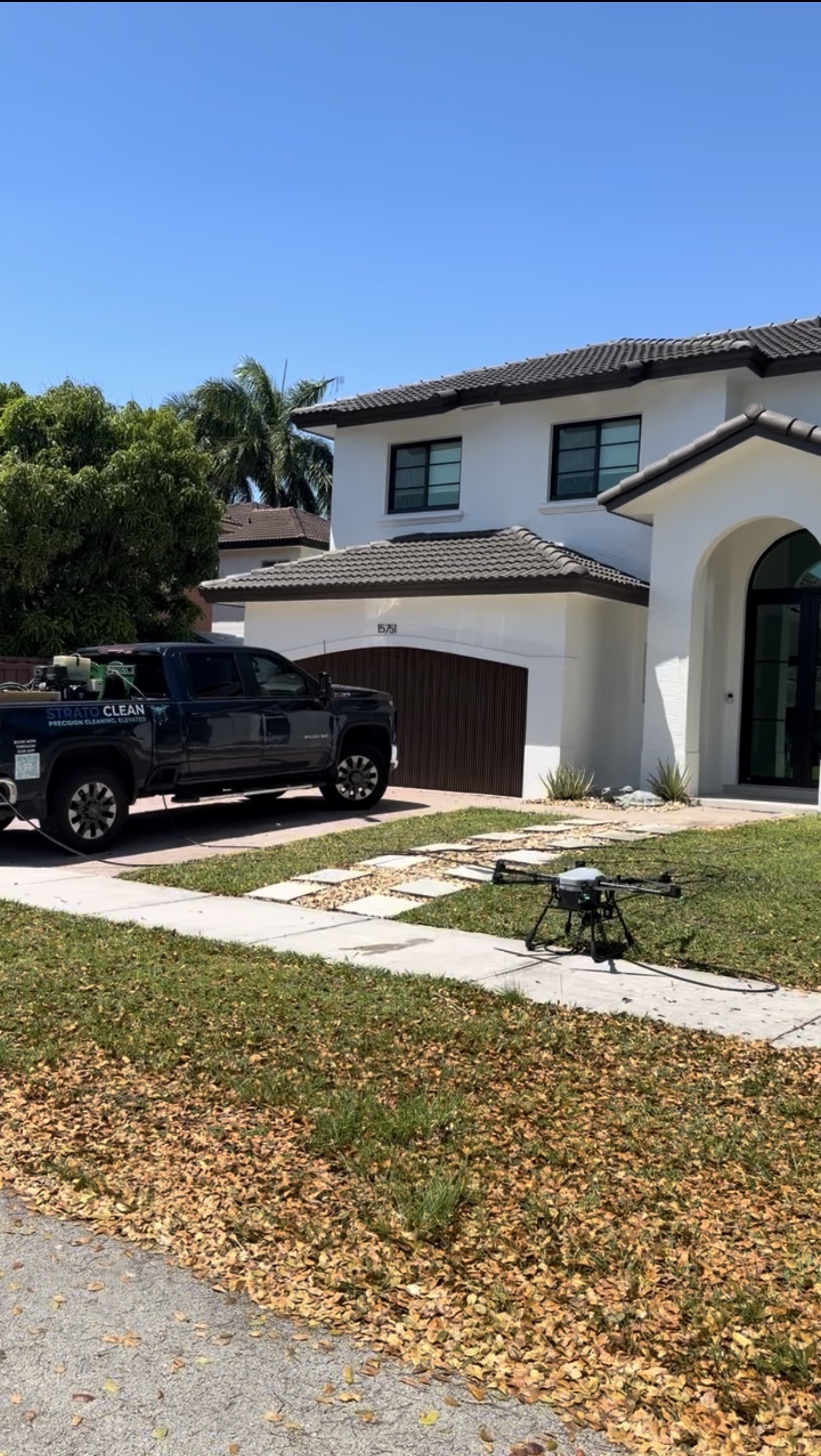
Traditional roof cleaning puts a person and their equipment on your roof, and roofs are not designed to be walked on. On barrel and flat tile, footsteps crack tiles — even careful crews break some, and cracked tiles leak. On shingle, foot traffic scuffs granules loose, and a dragged hose does more. Walking a wet, treated roof is also one of the most dangerous jobs in residential contracting. Beyond breakage, many roofing manufacturers take a dim view of foot traffic and high-pressure washing when warranty claims arise.
Drone roof cleaning removes every one of those problems at once. The aircraft applies the soft-wash solution from above in controlled passes while the crew stays on the ground. Zero foot traffic means zero cracked tiles, zero granule scuffing, and no ladders against your gutters. StratoClean’s patent-pending steerable nozzle directs spray up under eaves, along hips and valleys, and into the recesses a fixed sprayer misses — coverage a walking crew achieves only by walking more.
Soft wash versus pressure washing on roofing materials
High pressure and roofing do not mix. On asphalt shingle, a pressure washer strips the ceramic granules that are the shingle’s UV armor — visibly aging the roof in a single afternoon. On tile, concentrated PSI cracks tiles and blasts out the mortar at hips and ridges, and drives water under the tile into the underlayment. On metal, it can scour finishes and force water past laps and fasteners. The industry’s own standards bodies endorse low-pressure chemical cleaning for roofs precisely because pressure is the wrong tool.
A drone-applied soft wash uses pressure comparable to heavy rain. The work is done by the chemistry — a biodegradable solution matched to the roofing material and the growth on it — followed by dwell time and a gentle rinse. Shingle keeps its granules, tile keeps its mortar, metal keeps its finish, and the biological cause of the staining is actually dead.
Protecting your landscaping: the pre-soak and post-soak
The most overlooked part of professional roof cleaning happens in the flower beds. Roof runoff during a wash carries cleaning solution, and plants at the drip line deserve protection. Our crews pre-soak the soil and foliage around the home with clean water before treatment begins — hydrated soil and leaves absorb clean water first, so they take up far less of anything that lands afterward. During the wash, the ground crew keeps rinsing sensitive zones. When the roof work is done, everything gets a thorough post-soak, followed by a neutralizer application that renders any residual solution in the beds inert.
This is the chemistry-led approach to safety: biodegradable solutions, deliberate dilution, and a soak-treat-soak-neutralize sequence — rather than promises about where spray will or will not travel. It is the difference between a crew that has washed a few roofs and one that has built a procedure.
The StratoShield option: one application, years of clean
For homeowners who want the result to last, StratoClean offers StratoShield — a single-application roof treatment carrying a 2-year written warranty. Rather than delivering its full effect the same afternoon, StratoShield keeps working after application: the roof continues to clear for up to 6 months as rain progressively carries away the killed growth, and then stays clean for 2 to 5 years, because the treatment does not just remove the organisms — it makes the surface inhospitable to recolonization. It is the option we recommend for heavily shaded lots, oak-canopy neighborhoods, and anyone who never wants to think about roof streaks again. Our standard soft wash remains available for homeowners who want a faster visible result without the warranty.
Frequently Asked Questions
How does a drone clean a roof without anyone walking on it?
The aircraft applies a biodegradable soft-wash solution from above in controlled overlapping passes while the crew stays on the ground. A patent-pending steerable nozzle directs spray under eaves and into valleys and recesses. The solution kills the biological growth causing the stains, which then releases and rinses away — no ladders, no foot traffic, no cracked tiles.
Is soft washing better than pressure washing a roof?
For roofs, decisively yes. Pressure washing strips shingle granules, cracks tile, dislodges ridge mortar, and only removes the visible layer of growth — the surviving organisms regrow within months. Soft washing uses rain-level pressure and lets chemistry kill algae, mold, and Gloeocapsa magma at the root, so the roof stays clean for years.
Will roof cleaning chemicals hurt my plants?
Not with the right procedure. We pre-soak soil and foliage with clean water before treatment so plants hydrate on clean water and absorb little of anything afterward, keep rinsing sensitive zones during the wash, then post-soak everything and apply a neutralizer that renders residual solution inert. The solutions themselves are biodegradable.
What is StratoShield and how long does it last?
StratoShield is our single-application roof treatment backed by a 2-year written warranty. The roof continues to clear for up to 6 months as rain carries away killed growth, then stays clean for 2 to 5 years because the treated surface resists recolonization. The standard soft wash, by contrast, delivers a faster visible clean without the warranty.
Does drone roof cleaning work on tile, shingle, and metal roofs?
Yes — the solution and dilution are matched to the material. Tile keeps its mortar and no tiles crack because nothing touches the roof; shingle keeps its protective granules; metal keeps its finish. The zero-foot-traffic approach is especially valuable on barrel tile, where walking crews routinely break tiles.
How long until the roof looks clean?
With a standard soft wash, most of the change is visible the same day, with remaining traces rinsing off in subsequent rains. With StratoShield, the transformation is progressive — the roof keeps clearing for up to 6 months as weather carries away the dead growth, and then holds that clean state for years.
Related Services & Areas
- drone roof cleaning services
- soft wash services
- how drone building cleaning works
- drone pressure washing, explained honestly
- all drone cleaning services
Get a Straight Answer for Your Building
Tell us what you’re maintaining and we’ll tell you exactly how we’d clean it — method, timeline, and a firm number. Call (786) 244-0640, email info@stratoclean.com, or get an instant roof quote online.