How does drone building cleaning work? A step-by-step look at assessment, chemistry selection, airspace authorization, soft-wash application, and documentation.
Step 1: Assessment and measurement — before anyone flies
Every project starts on the ground, usually before we ever visit. We measure the building from satellite and street imagery, then confirm with a site walk: total facade area, elevations and setbacks, substrate types on each face, soiling severity, landscaping below the work zones, and where ground equipment can stage. Because the estimate needs no lift or scaffold survey, quoting is fast — but the assessment still decides everything that follows, from which chemistry we load to how many flight sequences the building needs.
This is also where site logistics get planned. Wash-water management is designed up front — job planning at StratoClean is led by an FDEP-trained Qualified Stormwater Management Inspector — and if a public sidewalk or lane sits under any elevation, our team holds FDOT Temporary Traffic Control Advanced certification and sets its own cones, signage, and pedestrian routing rather than subcontracting traffic control.
Step 2: Chemistry selection by substrate
There is no single building-washing solution, because there is no single building surface. Painted stucco, exposed concrete, EIFS, anodized aluminum, stainless, architectural glass, and natural stone each tolerate different cleaners — and each collects different soiling. South Florida facades typically carry biological growth (algae, mildew), atmospheric film, and, near the coast, salt and oxidation. We match a biodegradable soft-wash solution to each substrate on the building: a solution strong enough to break down growth at its source on concrete may be the wrong choice next to anodized window frames, so mixed facades get sequenced by material.
The soft-wash principle is the important part: the chemistry does the cleaning, not pressure. The solution is applied, allowed to dwell while it breaks down organic growth and film, and then rinsed away. That is why soft-washed surfaces stay clean longer than pressure-washed ones — growth is killed rather than sheared off at the surface, where it would regrow within months.
Step 3: Airspace authorization and flight planning
Commercial drone work happens inside a regulated airspace system. Before flying, we confirm the site’s airspace class and obtain any required authorization — much of urban South Florida sits under controlled airspace around Miami International, Fort Lauderdale, and Palm Beach airports, where flights need approval before takeoff. Our FAA-authorized pilots plan each flight around the building’s geometry: obstacle mapping, wind exposure on each elevation, and abort paths. None of this is visible to the client, but it is the difference between a professional aerial operation and someone with a drone and a pump.
Step 4: The wash — application, dwell, rinse
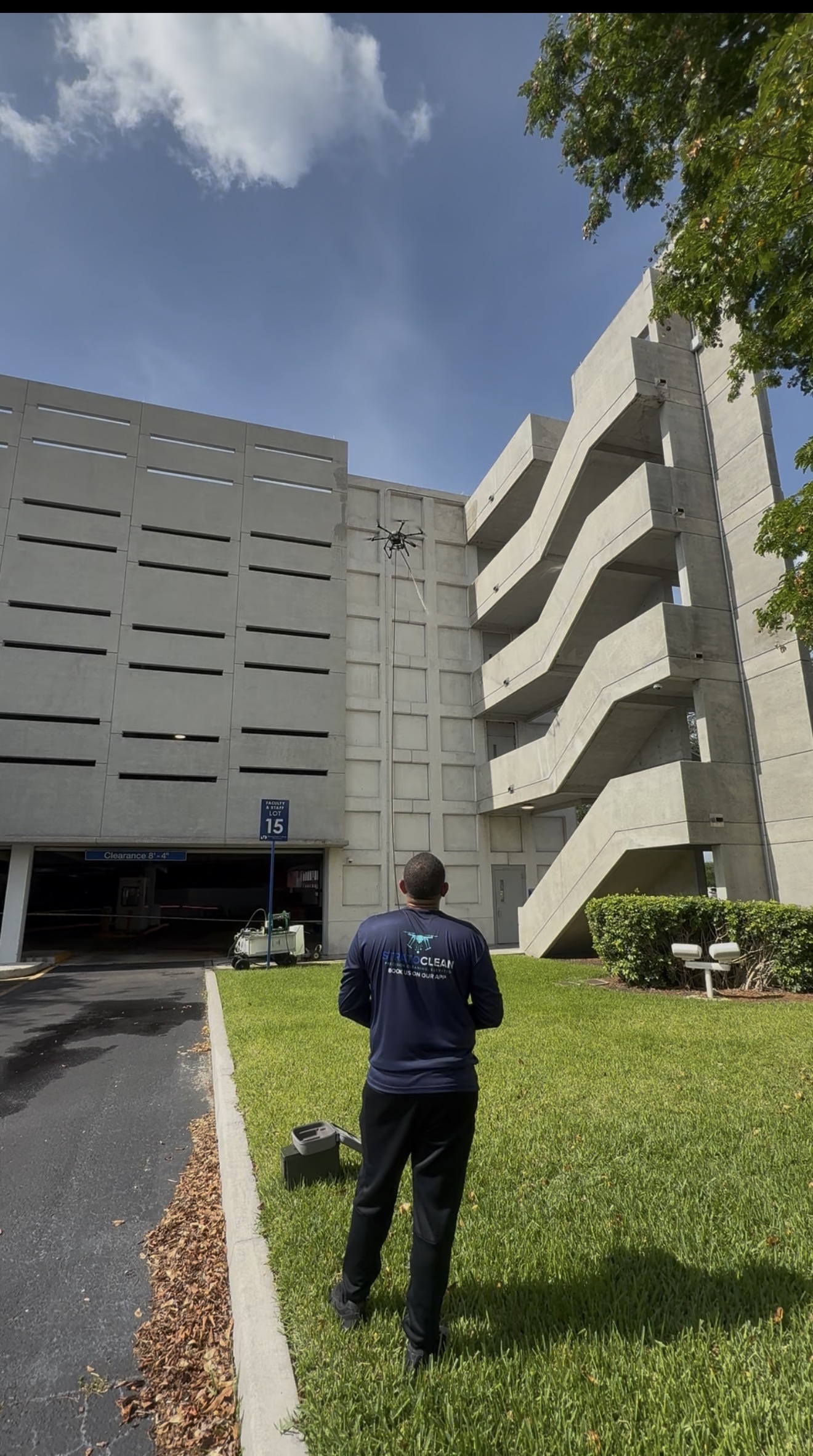
On job day, a compact crew stages ground equipment: tanks, pumps, and the feed line that supplies the aircraft. The drone flies the facade in controlled, overlapping passes, applying solution at low pressure across the full height of the structure. Depending on the site, the aircraft may operate tethered — power and fluid fed continuously from the ground, which extends flight time on large facades — or untethered for agile work around complex geometry. The practical reality is less dramatic than people expect: steady, methodical passes, one elevation at a time.
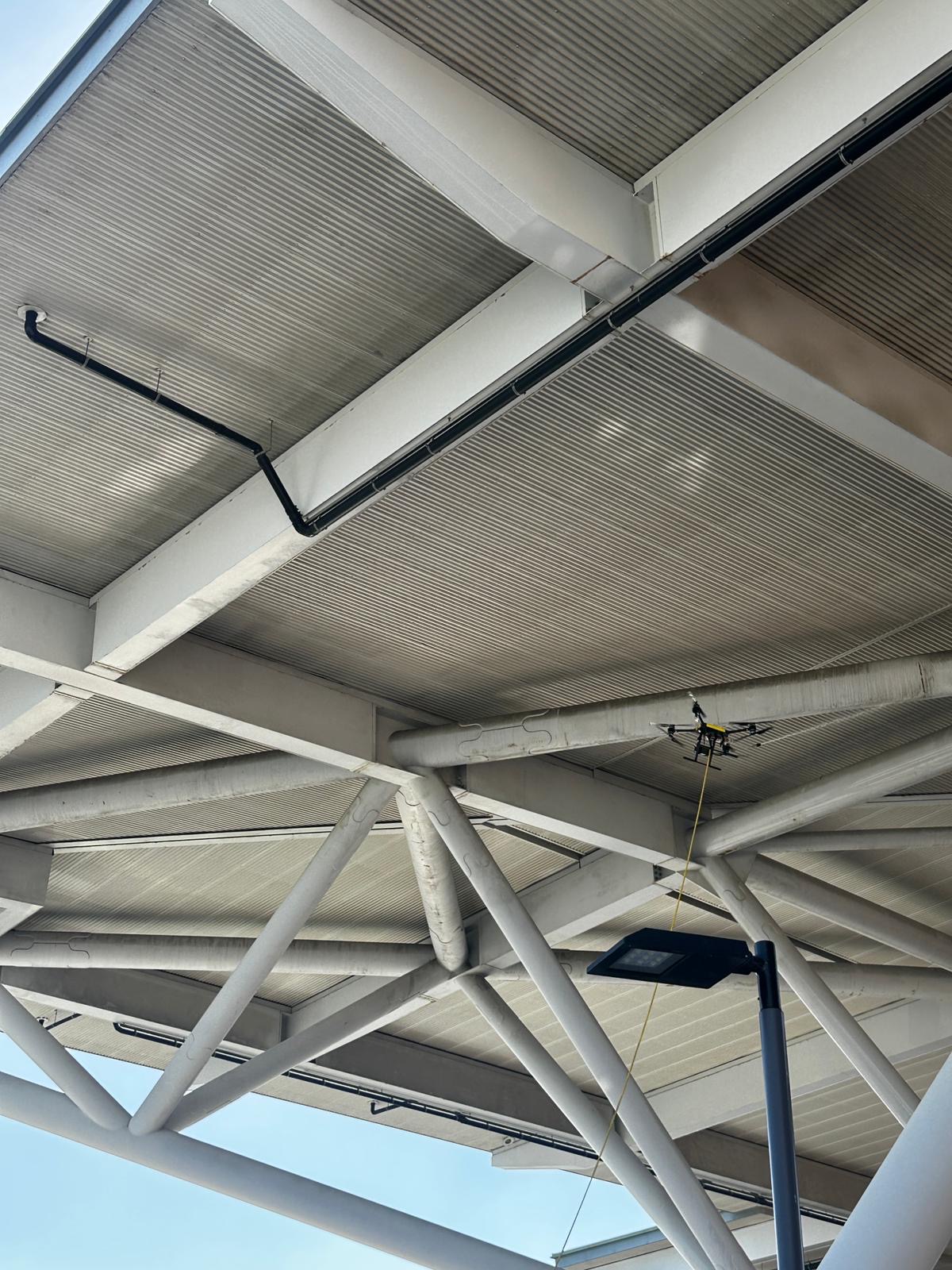
StratoClean aircraft carry a patent-pending steerable nozzle that redirects the spray stream independently of the drone’s position. That matters on real buildings, which are not flat walls: the nozzle angles solution up under eaves and soffits, into recessed balconies, and across setback returns that a fixed downward-pointing sprayer simply cannot reach. After application, the solution dwells — minutes, tuned to the substrate and soiling — and then the aircraft returns for the rinse pass, flooding the surface clean from the top down.
Work spanning many building types follows this same sequence. A facade program at a Gulf Coast hospital campus ran during normal visiting hours with no disruption inside; a Miami college parking structure had its elevated concrete walls washed without a single lane of the garage closing; a professional ballpark in the Palm Beaches had years of coastal oxidation lifted from its stainless facade in one mobilization.
Step 5: Documentation — and the honest limits
Every job ends with dated before-and-after imagery of each elevation, delivered as a documentation package for your maintenance records. Because the aircraft carries a camera through the entire wash, we also flag anything notable the flight reveals — cracking, rust staining, failed sealant — for your engineer or contractor to evaluate.
And the honest limits: drones do not fly in high wind, so gusty days trigger holds — we schedule around weather windows and finish when conditions allow, not by forcing marginal flights. Some airspace requires authorizations that add lead time. And a cleaning drone cleans; it does not caulk joints, repair spalls, replace sealant, or touch interior glass. Anyone promising a drone does everything is overselling. What it does — full-height, touchless exterior cleaning with nobody suspended at height — it does exceptionally well.
Frequently Asked Questions
How does a cleaning drone actually apply the solution?
The drone is fed by ground-based tanks and pumps, and sprays in controlled overlapping passes at low pressure. StratoClean aircraft add a patent-pending steerable nozzle that redirects the stream independently of the drone’s position — reaching up under eaves, into recessed balconies, and across setbacks that fixed sprayers miss. Solution dwells on the surface, then a rinse pass floods it clean.
Are cleaning drones tethered?
Both configurations exist and we use each where it fits. A tether feeds power and fluid continuously from the ground, extending flight time on large open facades. Untethered flight suits complex geometry where a trailing line would snag. The choice is made during flight planning, not on the fly.
Do you need permission to fly a drone near buildings?
Commercial operations must comply with federal drone regulations, and much of urban South Florida sits in controlled airspace around major airports where authorization is required before takeoff. We confirm airspace class and secure any needed approvals during planning — it is a standard part of every job, handled before the crew arrives.
What can drone cleaning not do?
It cannot make repairs — no caulking, sealant replacement, or patching — and it cannot clean interior glass or fly safely in high winds, which occasionally shifts schedules. It is a cleaning method, not a maintenance cure-all. What it eliminates is the access problem: scaffolding, swing stages, lifts, and people suspended at height.
Is the cleaning solution safe for landscaping and the building?
The wash is chemistry-led and biodegradable, matched to each substrate so delicate materials like anodized frames and EIFS are cleaned with appropriate solutions rather than force. Landscaping below work zones is accounted for during assessment, and wash-water management is planned by an FDEP-trained Qualified Stormwater Management Inspector on our team.
How long does a drone building cleaning take?
Most buildings are completed in one to two days, because there is no access equipment to erect or dismantle. Ground setup takes under an hour, and the drone covers facade area far faster than any suspended crew. Large campuses or multi-building properties are sequenced elevation by elevation in a single mobilization.
Related Services & Areas
- drone building cleaning services
- how drone window cleaning works
- how drone roof cleaning works
- soft wash services
- concrete and wall cleaning
- all drone cleaning services
Get a Straight Answer for Your Building
Tell us what you’re maintaining and we’ll tell you exactly how we’d clean it — method, timeline, and a firm number. Call (786) 244-0640, email info@stratoclean.com, or get an instant roof quote online.