How does drone window cleaning work? Deionized pure water, glass-safe pressure, and why windows dry spot-free with no squeegee — explained step by step.
The core idea: purified water instead of a squeegee
Traditional window cleaning is a two-part act: wash the glass, then squeegee it dry before the water can leave marks. Drone window cleaning eliminates the second part entirely by changing the water itself. Ordinary tap water carries dissolved minerals — calcium, magnesium, silica, salts — measured as total dissolved solids, or TDS. When a droplet of tap water evaporates on glass, the water leaves but the minerals stay, and that residue is the spot. Squeegeeing exists purely to remove the water before it can evaporate in place.
Deionized water flips the problem. Run water through ion-exchange resin and its dissolved minerals are stripped out, bringing TDS down to essentially zero. When zero-TDS water evaporates on glass, there is nothing left behind — no minerals, no residue, no spot. The glass can be rinsed thoroughly and simply left to dry. This is the same principle window cleaners use with water-fed poles at street level; the drone takes it to elevations no pole can reach.
Why pure water cleans better than it sounds
There is a second property that makes deionized water an active cleaner, not just a spot-free rinse. Stripped of its ions, pure water is chemically hungry — it aggressively pulls dissolved and loosely bonded material off surfaces as it seeks to re-mineralize. On glass, that means it lifts atmospheric film, salt haze, and light organic soiling on contact. For typical maintenance cleans on commercial glass, purified water alone does the work. Heavier soiling — construction residue, hard-water staining from lawn sprinklers hitting the glass, baked-on grime — gets a detergent pass first, then a pure-water rinse to finish spot-free.
Pressure is deliberately modest. Glass itself is durable, but glazing systems are not just glass: they are seals, gaskets, and insulated units whose edge seals high-PSI water can compromise. The drone applies water at pressures appropriate for glazing — enough to sheet the surface and flush soiling, never enough to stress seals. The rinse also sheets across frames, mullions, and exterior sills as it flows down the facade, so the whole glazing system comes clean, not just the vision glass. Exterior tracks and screens on accessible frames get flushed in the same pass; heavily clogged screens are the one component that sometimes still merit hand attention.
The process, start to finish
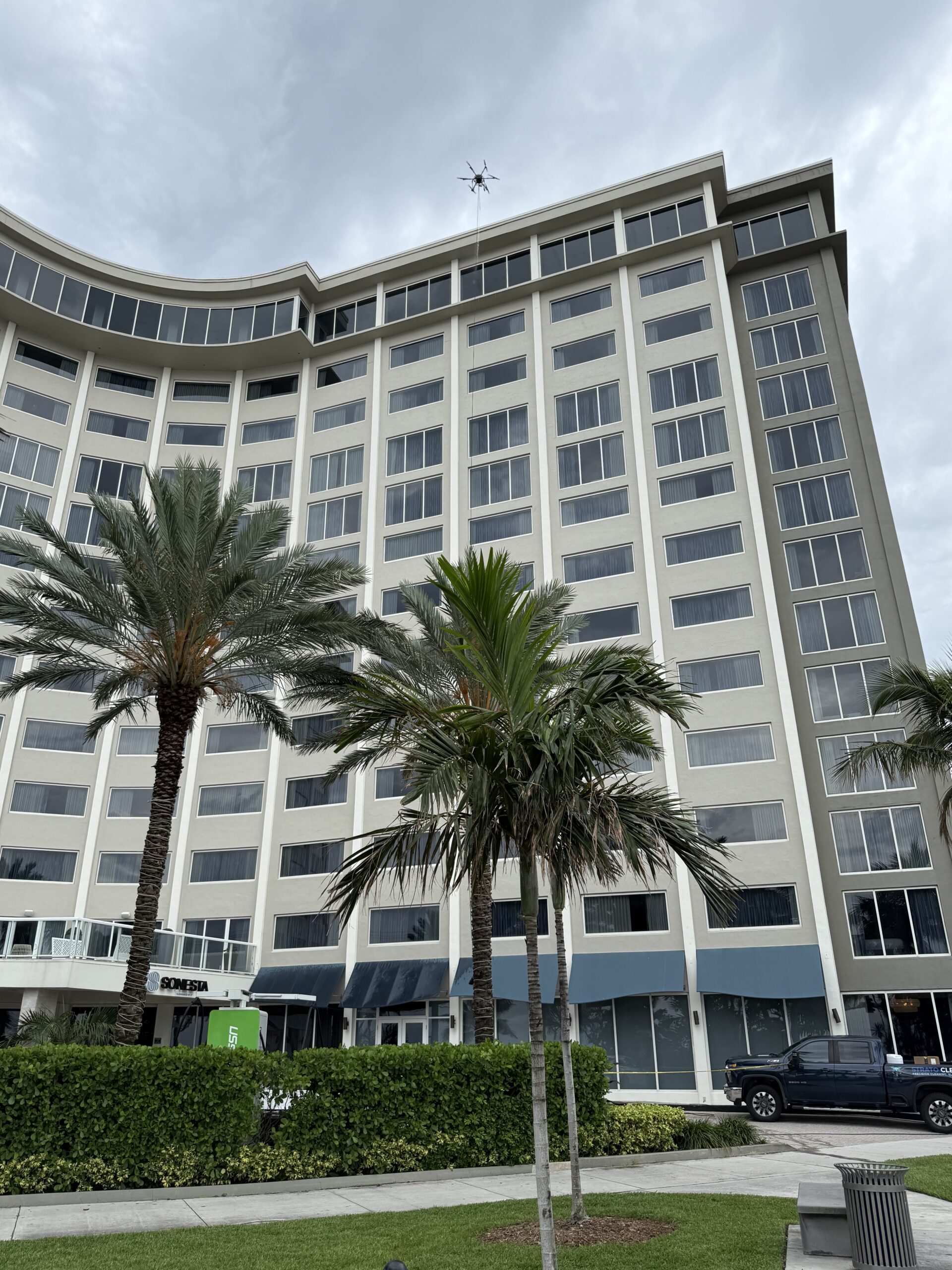
A job begins with assessment: glass area, facade geometry, soiling type, and a TDS reading of the site’s source water, which determines how the purification rig is configured. On job day, the ground station filters and deionizes water on site, feeding the aircraft continuously. The drone works the facade top down — always top down, so rinse water flows over glass that has not yet been cleaned rather than over finished work — in overlapping passes, one elevation at a time.
Each pass washes glass, frames, and spandrel together. The operator watches a live feed from the aircraft, holding on any pane that needs a second pass. When an elevation is finished, it is simply left to dry: with near-zero TDS in the final rinse, evaporation leaves nothing behind. There is no lens-by-lens detailing stage because the physics has already handled it.
High-rise logistics: the drone versus rope crews
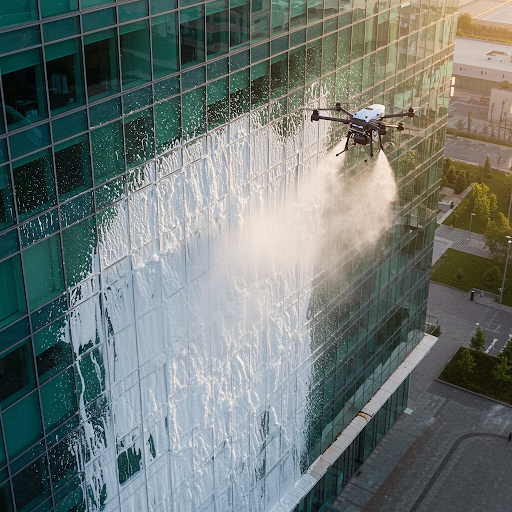
On a tower, the comparison with traditional methods is stark. A rope-access or swing-stage operation needs certified roof anchors, rigging inspections, weather margins for suspended workers, and it cleans one drop — one vertical strip of building — at a time. A large tower can keep a rope crew on site for weeks, with equipment visible outside tenants’ windows the entire time. The drone crew arrives with a van and a water rig, sets up in under an hour, and covers full elevations in continuous flight, typically finishing in days what suspended access does in weeks.
The safety math is simpler still: nobody is hanging from the building. Falls from height remain the defining hazard of facade work, and drone window cleaning removes the exposure completely rather than managing it. Wind still rules the schedule — drones hold in gusty conditions just as swing stages do — but a weather hold for a drone means a delayed flight, not a person stranded mid-facade. For occupied buildings, there is also the quiet-enjoyment factor: a drone making passes for two days disrupts tenants far less than a month of rigging, and it leaves no anchor loads on the roof membrane.
Frequently Asked Questions
Why does deionized water dry without spots?
Water spots are not water — they are the dissolved minerals left behind when water evaporates. Deionization strips those minerals out, taking total dissolved solids to essentially zero. When zero-TDS water evaporates on glass there is nothing to leave behind, so the pane dries spot-free with no squeegee needed.
Does drone window cleaning use any soap?
For maintenance cleans, usually not — purified water alone lifts atmospheric film and light soiling because deionized water actively pulls material off surfaces as it re-mineralizes. Heavier soiling gets a biodegradable detergent pass first, always finished with a pure-water rinse so the glass still dries spot-free.
Can the water pressure damage windows or seals?
The application is deliberately low-pressure. Glazing systems include gaskets and insulated-glass edge seals that high-PSI water can compromise, so the drone sheets water at pressures suited to glass — enough to flush soiling, never enough to stress the assembly. This is one of the core differences from pressure washing.
Does it clean frames, sills, and tracks too?
Yes. The rinse sheets across frames, mullions, spandrel panels, and exterior sills as it flows down the facade, so the full glazing system comes clean in the same passes as the vision glass. Heavily clogged exterior screens are the one element that occasionally still benefits from hand attention.
How does drone window cleaning compare to rope-access crews on a high-rise?
Rope and swing-stage work cleans one vertical drop at a time and depends on certified roof anchors, rigging, and workers suspended at height — often weeks on a large tower. A drone covers full elevations in continuous flight from a ground setup that takes under an hour, typically finishing in days, with no one leaving the ground and no loads on the roof.
What weather stops a drone window cleaning job?
Wind is the main constraint — gusty conditions trigger flight holds, just as they halt swing-stage work. Rain pauses operations as well, though a passing shower on freshly pure-water-rinsed glass does far less harm than on tap-water-washed glass. Crews schedule around weather windows and resume when conditions allow.
Related Services & Areas
- drone window cleaning services
- high-rise and condo exterior cleaning
- how drone building cleaning works
- commercial office exterior cleaning
- solar panel cleaning with deionized water
- all drone cleaning services
Get a Straight Answer for Your Building
Tell us what you’re maintaining and we’ll tell you exactly how we’d clean it — method, timeline, and a firm number. Call (786) 244-0640, email info@stratoclean.com, or get an instant roof quote online.