Rope access vs drone cleaning: an honest look at safety exposure, insurance burden, speed, and cost drivers — and the jobs where rope crews still win.
What rope access does well — and where it stops
Rope access deserves a fair hearing, because it solved a real problem. Before certified rope technicians, cleaning or repairing a tower facade meant swing stages or full scaffolding. A trained two-person rope team can rig off certified roof anchors in a morning and put skilled hands directly on the building — and for some tasks, hands are exactly what the job needs. Glass restoration, scratch and stain polishing, caulk and sealant replacement, gasket work, spot facade repairs, and close-up condition surveys are all tactile work. A drone cannot cut out a failed sealant joint or polish a scratch out of tempered glass. If your building needs that work, hire a rope crew and pay them well.
Washing is a different kind of job. Cleaning a facade is coverage work, not tactile work: apply the right solution, let it dwell, rinse thoroughly, move on. Nothing about that requires a human body hanging in front of the glass. Once you separate the tactile tasks from the coverage tasks, the comparison gets much simpler — and much less flattering to rope access as a washing method.
The safety math: suspended humans versus a ground crew
Every rope drop is a person suspended over the side of your building, all day, in South Florida heat and coastal wind. Good rope companies manage that risk seriously — redundant lines, rescue plans, weather cutoffs — but managed risk is not the same as eliminated risk. Falls from height remain among the leading causes of serious injury and death in exterior building work, and every hour of suspension is exposure your property sits underneath.
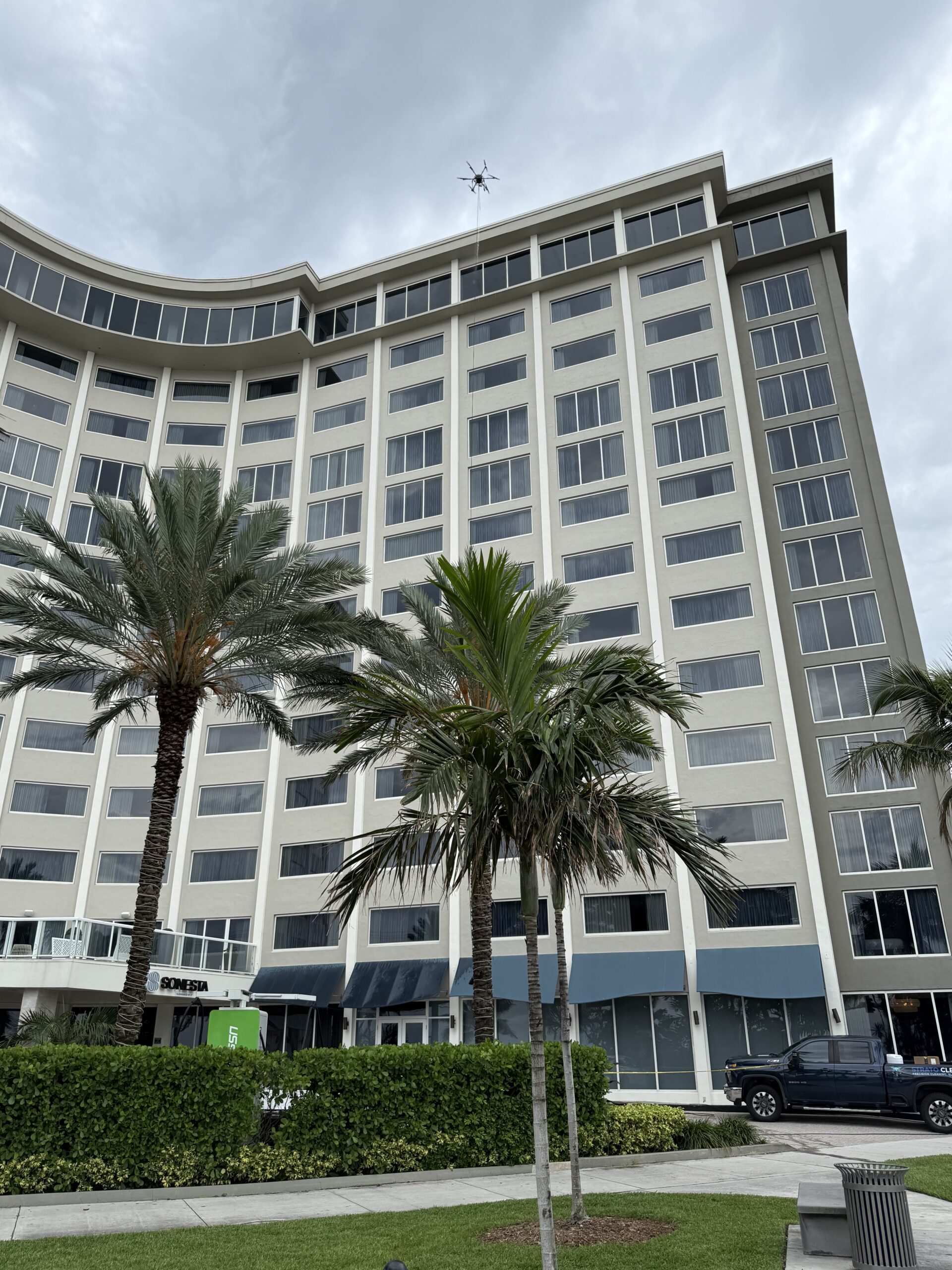
Drone cleaning removes the entire category. The crew stays on the ground behind a cone line, the drone carries the spray to elevation, and the worst-case mechanical failure is a machine on a pre-planned flight path flown by FAA-authorized pilots — not a person. When something goes wrong at 300 feet, you want it to be equipment, not a technician. That distinction also changes what happens below: no exclusion zones under suspended workers for days at a time, no dropped-tool hazard over entrances, and no rescue-scenario planning involving your fire department.
The insurance burden quietly shifts onto your building
Here is the part of rope access that rarely makes the proposal: the building carries obligations, not just the vendor. Suspended work rigs off your roof anchors, and those anchorages must be engineered, certified, and inspected on a recurring schedule. If your building lacks certified anchor points, you are paying for an engineering evaluation and possibly anchor installation before the first drop happens. Your insurer will want to see the anchor certifications. Your risk manager will want the vendor’s fall-protection program on file. If a suspended worker is injured, your building is part of the claim conversation because the rigging attached to your structure.
With drone washing, nothing attaches to the building and no worker touches it. The liability picture stays where it belongs — on the contractor’s operation. StratoClean is fully insured, and our crews never set foot on your roof or rig to your parapet for a facade wash. For associations and property managers, that difference shows up as a shorter COI review, fewer conditions from the carrier, and no anchor-certification file to maintain for cleaning purposes.
Speed: one drop at a time versus continuous passes
Rope access cleans in vertical strips. A technician descends one drop — roughly the width of their reach — then the team de-rigs, repositions anchors, and drops again. On a wide elevation that means dozens of drops, each with rigging time attached, and every marginal-weather day pushes the schedule. A large facade can hold a rope team for weeks.
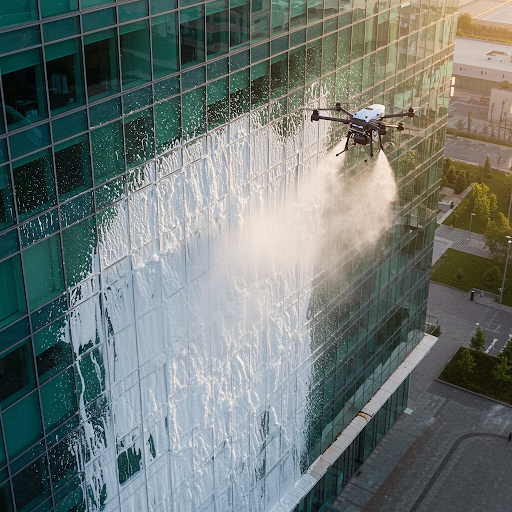
A drone flies the facade in continuous overlapping passes, covering in an hour what a rope drop covers in a day. We washed the elevated concrete walls of a Miami college parking structure and full facade elevations at a Gulf Coast hospital campus in single mobilizations — jobs that would have been multi-week rope or lift projects. Our patent-pending steerable nozzle also handles the geometry that used to justify a rope drop in the first place: eaves, recessed balconies, soffits, and undersides that a fixed downward spray cannot reach.
What actually drives the cost of each method
Rope-access pricing is built on certified-technician day rates multiplied by drops, plus rigging time, plus weather standby. Because the work is slow by geometry, the labor multiplier dominates: the wider and taller the elevation, the more drops, the more days, the more you pay for access rather than cleaning. Drone pricing is driven by surface area and soiling level, because access is nearly free — the drone reaches the fortieth floor as easily as the fourth. The taller the building, the more decisively the economics tilt toward the drone. For an exact number on your building, the fastest route is the instant quote at https://stratoclean.com/quote/.
The honest verdict: match the method to the task
Use rope access for what requires hands: glass restoration, sealant and caulking work, repairs, and tactile inspections. Use drone soft washing for what requires coverage: facade washing, window cleaning, and rinse work at height. The two are not enemies — a smart maintenance plan uses drone cleaning for the recurring wash cycle and calls a rope crew only when there is genuinely tactile work to do, which cuts rope days to a fraction of what an all-rope program burns. That split keeps workers off the side of your building except when their hands are truly needed, and it is the plan we recommend even when it means recommending someone else for part of the scope.
- Rope access wins: glass restoration and polishing, caulking and sealant replacement, facade repairs, close-up surveys
- Drone wins: facade washing, high-rise window cleaning, full-elevation soft wash, recurring maintenance programs
- Either works, drone is faster: rinse-downs after construction, salt-film removal, post-storm exterior cleanup
Frequently Asked Questions
Is drone cleaning safer than rope access?
Yes — drone cleaning keeps the entire crew on the ground, while rope access suspends a technician at height for every drop. Professional rope companies manage that risk with redundant lines and rescue plans, but drone washing eliminates the fall-exposure category entirely, which is why it is increasingly the default for wash work, with rope reserved for repairs.
Is rope access cheaper than drone cleaning for building washing?
Usually not on washing scopes. Rope pricing is built on certified-technician day rates multiplied by the number of drops, and washing a wide facade takes many drops over many days. Drone cleaning covers the same area in continuous passes in a fraction of the time, so labor hours — the biggest cost input — drop sharply. Rope remains competitive for tactile work like sealant replacement, where a drone cannot do the task at all.
Can a drone replace rope access window cleaning?
For routine window washing, yes — a drone applies solution and a purified-water rinse across full elevations without anyone leaving the ground, and dries spot-free without squeegee contact. Rope access is still required for glass restoration, scratch polishing, and gasket or sealant work, which need a technician’s hands on the glass.
Do building owners need certified anchor points for rope access?
Yes. Suspended rope work rigs to the building, so roof anchorages must be engineered, certified, and inspected on a recurring schedule, and buildings without compliant anchors face an engineering evaluation before work can start. Drone cleaning attaches nothing to the structure, so no anchor certification is needed for washing.
How long does rope access cleaning take on a high-rise?
A rope team cleans one vertical drop at a time, so a wide elevation can take weeks including rigging, repositioning, and weather standby days. Drone cleaning covers the same facade in continuous passes, typically completing in a single mobilization of hours to a few days depending on building size.
When is rope access the right choice over a drone?
Whenever the job needs hands on the surface: glass restoration, caulk and sealant replacement, facade repairs, and close-up condition surveys. Washing and rinsing are coverage tasks that a drone does faster and with no one at height, so the best maintenance plans use drones for the wash cycle and rope crews only for tactile work.
Related Services & Areas
- drone window cleaning
- drone building and facade cleaning
- high-rise and condo exterior programs
- all drone cleaning services
- drone cleaning in Miami
- instant online quote
Get a Straight Answer for Your Building
Tell us what you’re maintaining and we’ll tell you exactly how we’d clean it — method, timeline, and a firm number. Call (786) 244-0640, email info@stratoclean.com, or get an instant roof quote online.